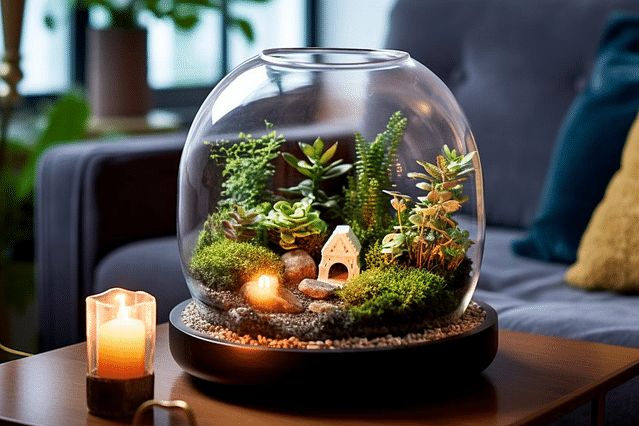
You spend an hour carefully arranging a terrarium — layering the soil, placing each plant just right, standing back to admire it. Then a week passes and something has gone wrong. Leaves are yellowing. A few plants look like they’re melting. The whole thing feels like a failure before it even had a chance to begin. What most people don’t realize until that moment is that plant selection makes or breaks an open terrarium, far more than the container choice or the arrangement style.
The encouraging part is that once you understand what actually works, open terrariums become some of the most rewarding and low-maintenance displays you can keep indoors. This guide walks through the 15 best open terrarium plants, explains what makes each one genuinely suitable for open container life, and gives you the care knowledge you need to keep them looking their best for months and years ahead.
What Makes a Plant Perfect for an Open Terrarium?
It helps to think about what an open terrarium actually is before choosing what goes inside it. Unlike closed setups — which create their own humid microclimate — open terrariums are exposed to the surrounding air. Glass bowls, geometric terrariums, lidless fishbowls, and open-top frames all fall into this category. They experience constant airflow, relatively low ambient humidity, and faster soil drying between watering sessions.
That environment is genuinely challenging for moisture-loving tropical species. Ferns, mosses, and humidity-dependent plants struggle quickly in these conditions, often showing stress within days of being placed inside. The best open terrarium plants behave very differently. They are drought-tolerant or semi-drought-tolerant by nature, comfortable in low-humidity conditions, and compact enough to suit the scale of most containers without outgrowing their space too quickly.
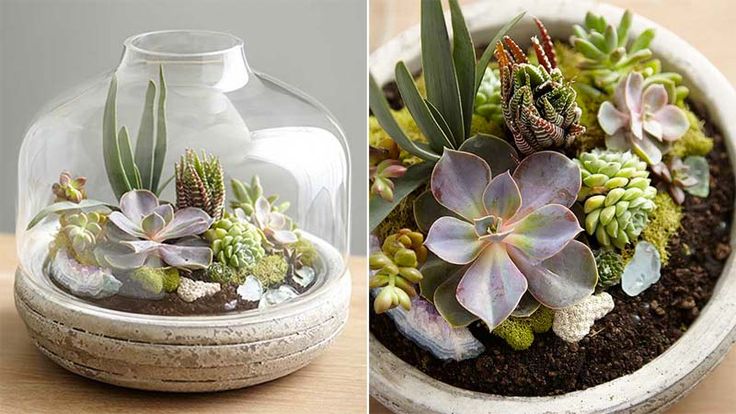
There is also an aesthetic dimension worth considering. Open terrariums tend to be display pieces as much as they are plant habitats. The best open terrarium plants for these arrangements carry visual weight — they offer interesting textures, sculptural forms, or color variation that makes the composition worth looking at even when nothing is blooming.
15 Best Open Terrarium Plants Worth Growing
1. Echeveria (Echeveria spp.)
Echeverias have become something of a standard for open terrarium arrangements, and it is easy to understand why. Their symmetrical rosette form, soft pastel tones, and fleshy leaves create an almost jewel-like quality inside a glass container. They are also genuinely forgiving plants — they handle the dry conditions of open terrariums without complaint and actually prefer the low-humidity environment that would stress many other species.
For best results, plant them in a well-draining cactus mix and position them where they receive bright indirect light. Watering every one to two weeks is typically sufficient, though this varies with your climate and the season. They are among the best open terrarium plants for beginners precisely because the conditions that would harm most houseplants — dry air, fast-draining soil, infrequent watering — are exactly what echeveria prefers.
2. Haworthia (Haworthia spp.)
Many succulents fail in rooms without strong natural light. Haworthia does not. These compact plants are one of the few genuinely low-light-tolerant options among the best open terrarium plants, which makes them practical for offices, shelves, and interior spaces that don’t catch direct sun. Their striped, pointed leaves have a structured, almost architectural quality that translates well inside glass containers.
Haworthia grows slowly and rarely spreads beyond a few inches in diameter, which means it fits comfortably in smaller open terrariums without threatening to take over the arrangement. If you are working with limited light conditions, this plant belongs near the top of your list.
3. Sedum (Sedum spp.)
Few genera offer as much variety within a single plant family as sedum. Some varieties are upright and compact. Others trail softly over container edges. Some have tiny, bead-like foliage — such as Sedum morganianum, commonly known as burro’s tail — while others form broad, flat clusters in shades of green, burgundy, or silver. You could, in theory, build an entire terrarium arrangement using only different sedum varieties and still achieve genuine visual diversity.
What makes sedum especially well-suited to open terrarium life is its resilience. It handles irregular watering without much visible protest, bounces back from dry spells reliably, and adds a sense of movement and texture that more rigid succulents cannot provide. As one of the best open terrarium plants for creating variety within a cohesive arrangement, sedum is a dependable choice across skill levels.
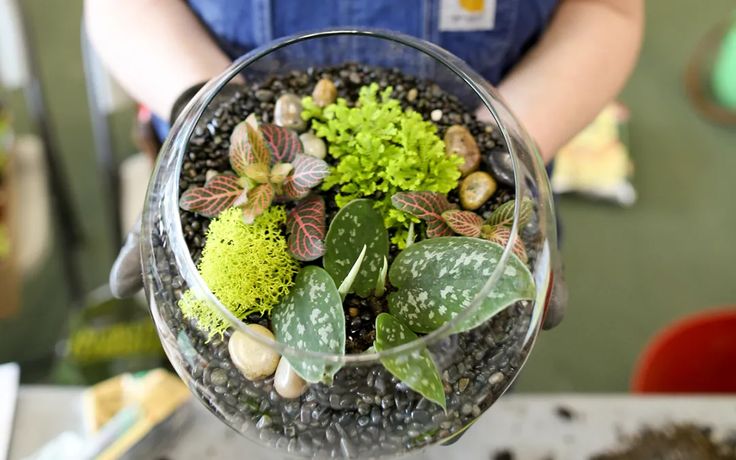
4. Aloe Vera
Young aloe vera plants are a natural fit for medium to large open terrariums. Their upright, thick leaves bring a boldness to arrangements that rounder, lower-growing succulents cannot replicate. There is also a practical appeal — aloe gel has genuine soothing properties, and keeping a small plant within arm’s reach of the kitchen has a quiet usefulness that most decorative plants lack.
The main consideration with aloe is growth. It does not stay small indefinitely, and a plant that fits neatly into a terrarium today may outgrow that space within a year or two. Choosing a young specimen and being prepared to transplant it when needed is the sensible approach. As far as the best open terrarium plants go, aloe offers a combination of visual presence and practical value that few others match.
5. Cactus Varieties (Mammillaria, Gymnocalycium, Cereus)
There is something particularly satisfying about the pairing of a small cactus and a geometric glass container. Mammillaria forms dense, rounded spheres covered in fine white spines that catch the light. Gymnocalycium stays compact, occasionally producing small, delicate flowers that feel like a reward for patient care. Cereus grows slowly upward, adding vertical interest to arrangements that might otherwise feel flat.
Cacti belong among the best open terrarium plants for one straightforward reason: they require almost nothing. Water them monthly in winter, every two to three weeks during warmer months, and keep them in the brightest available spot. Beyond that, they largely take care of themselves.
6. Air Plants (Tillandsia spp.)
Air plants operate on an entirely different set of rules than most terrarium inhabitants. They absorb moisture and nutrients through their leaves rather than roots, which means they don’t require soil at all. Inside a terrarium, this creates genuine creative freedom — they can be placed on decorative rock, driftwood, or gravel, positioned at any angle, and arranged without the constraints that soil-dependent plants impose.
Closed or semi-closed containers often create conditions that are too humid for air plants, leading to rot at the base. Open terrariums, with their natural airflow, are far more suitable. Misting two to three times per week keeps them healthy. Among the best open terrarium plants for unconventional, soil-free arrangements, Tillandsia is in a category of its own.
7. Sempervivum (Hens and Chicks)
Sempervivum has a quiet charm that grows on you over time. The main rosette — the “hen” — gradually produces smaller rosettes around it — the “chicks” — slowly and naturally filling the available space in a way that looks organic rather than planted. Colors shift between green, burgundy, and bronze depending on light levels and temperature, adding a living, changing quality to the arrangement.
One detail worth knowing: sempervivum benefits from mild temperature variation, performing well in terrariums positioned near windows that cool slightly in the evening. This makes it one of the best open terrarium plants for homes where indoor temperatures fluctuate naturally with the seasons.
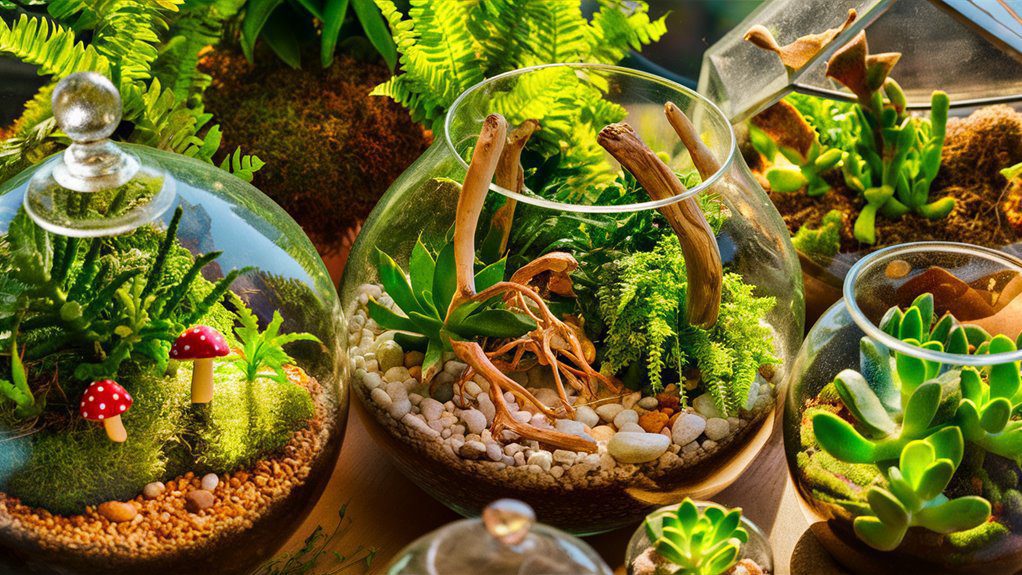
8. Sansevieria (Snake Plant)
The compact varieties of sansevieria — particularly Sansevieria trifasciata ‘Hahnii’, often called the bird’s nest snake plant — are among the most practical choices for open terrarium use. They tolerate low light, go several weeks without water, resist most common houseplant pests, and maintain their form reliably without any demanding care routine.
For people who travel regularly, work long hours, or simply want a terrarium that functions as a display piece without requiring frequent attention, sansevieria is the most sensible anchor plant. It is arguably the most forgiving of all the best open terrarium plants on this list, and that is not a small claim given the competition.
9. Zebra Plant Haworthia (Haworthia fasciata)
At first glance, zebra haworthia looks similar to aloe — same upright leaf structure, same pointed tips. Look more closely and the difference becomes clear: bold white horizontal bands run across each dark green leaf, creating a graphic, high-contrast pattern that is genuinely eye-catching inside a glass container. It grows slowly, stays compact, and prefers indirect rather than direct sunlight, making it well-suited to desk and bookshelf placements where most succulents would struggle.
10. Jade Plant (Crassula ovata)
A young jade plant brings something different to a terrarium — a sense of age and permanence that faster-growing plants cannot replicate. The thick, oval leaves and gradually woody stems create a miniature tree quality that feels almost bonsai-like in a glass container. Jade plants are slow growers, which means a small cutting can remain terrarium-appropriate for a year or more before it begins to outgrow its space.
Bright light and restrained watering are the primary requirements. Root rot from overwatering in poorly draining soil remains the most common problem with jade plants, as with most of the best open terrarium plants in the succulent family. Getting the soil mix right from the start prevents most issues.
11. String of Pearls (Senecio rowleyanus)
String of pearls is one of the most visually distinctive plants you can include in an open terrarium. Each stem carries a succession of small, perfectly round beads of foliage, creating the appearance of living jewelry cascading from a container. In a taller open glass terrarium, allowing the stems to trail over the edge produces a dramatic visual effect that draws attention from across the room.
It requires bright light and careful watering — too little and the pearls begin to shrivel, too much and the plant rots from the roots upward. This makes it slightly more demanding than some of the other best open terrarium plants on this list. But for arrangements where visual impact matters, the effort is well worth making.
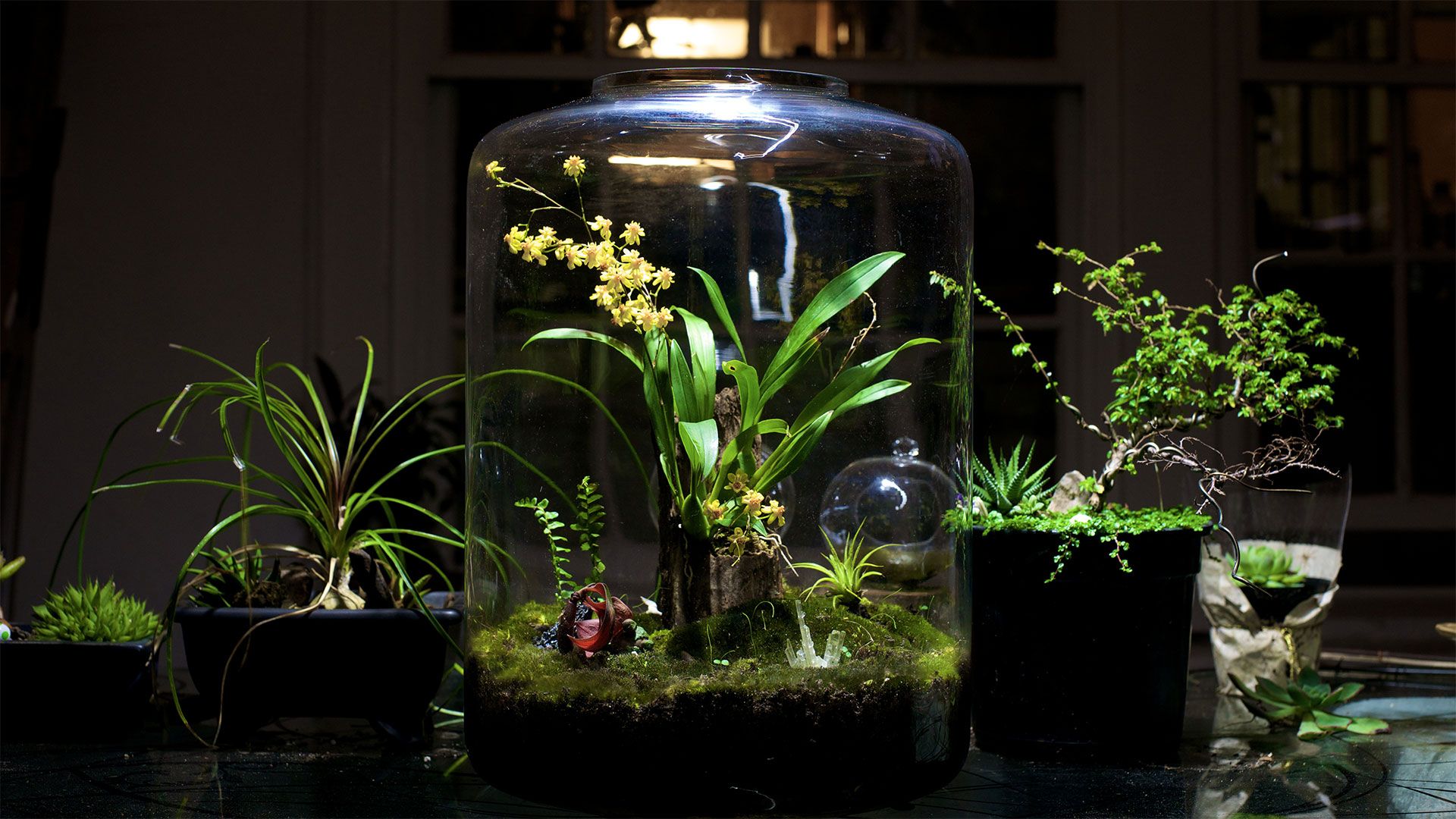
12. Panda Plant (Kalanchoe tomentosa)
The panda plant is defined by texture more than any other quality. Its leaves are covered in dense, silvery-white hairs with rust-colored tips, giving each leaf a velvet-like surface that genuinely invites touch. Guests encountering it for the first time almost always reach out to feel it, which says something about how unusual it looks inside a glass container.
It performs best in bright light with minimal watering. Position it somewhere prominent in the arrangement — a spot where the texture can be appreciated up close rather than buried behind other plants. It is one of the best open terrarium plants for adding tactile interest to an otherwise visual display.
13. Lithops (Living Stones)
Lithops are among the most unusual plants in cultivation. They are naturally camouflaged to resemble small pebbles — a survival adaptation from their native South African desert habitat — and they barely look like plants at all until autumn, when they produce bright, daisy-like flowers from between their paired leaves.
They require very little water, and overwatering kills them faster than almost any other form of neglect. A sandy, free-draining mix and watering only a handful of times per year is all they need. For a desert-themed or geological open terrarium arrangement, lithops are the best open terrarium plants for creating a sense of something genuinely rare and unusual. Nothing else quite captures the same feeling.
14. Graptoveria
Graptoveria is a hybrid between Graptopetalum and Echeveria, and it inherits useful qualities from both parent plants. It forms tight, tidy rosettes in soft shades of pink, lavender, and silver-green, and it proves more robust than either parent when it comes to temperature tolerance and recovery from underwatering. For anyone designing a terrarium around a pastel or jewel-toned color palette, graptoveria functions well as the visual anchor of the arrangement.
15. Moss (Dried or Living Scotch Moss)
Most mosses need high humidity to survive, which makes them poor candidates for open terrariums. Scotch moss — Sagina subulata — is a practical exception. It handles drier conditions better than most of its relatives and contributes a dense, green carpet effect that works as a natural-looking ground cover between taller plants. It softens the overall composition, fills visual gaps without competing for vertical space, and gives an arrangement the kind of finished, considered quality that bare gravel cannot achieve. For those reasons, it earns its place among the best open terrarium plants even though it requires slightly more attention to moisture than the succulents surrounding it.
Open Terrarium Plant Care: Quick Reference Table
| Plant | Light Needs | Watering Frequency | Humidity Tolerance | Difficulty |
|---|---|---|---|---|
| Echeveria | Bright indirect | Every 1–2 weeks | Low | Easy |
| Haworthia | Low to medium | Every 2–3 weeks | Low–medium | Easy |
| Cactus | Bright direct | Monthly | Very low | Easy |
| Air Plants | Bright indirect | Mist 2–3x/week | Low–medium | Moderate |
| String of Pearls | Bright indirect | Every 2 weeks | Low | Moderate |
| Lithops | Bright direct | Few times/year | Very low | Moderate |
| Jade Plant | Bright indirect | Every 2–3 weeks | Low | Easy |
| Sansevieria | Low to bright | Every 3–4 weeks | Low | Very Easy |
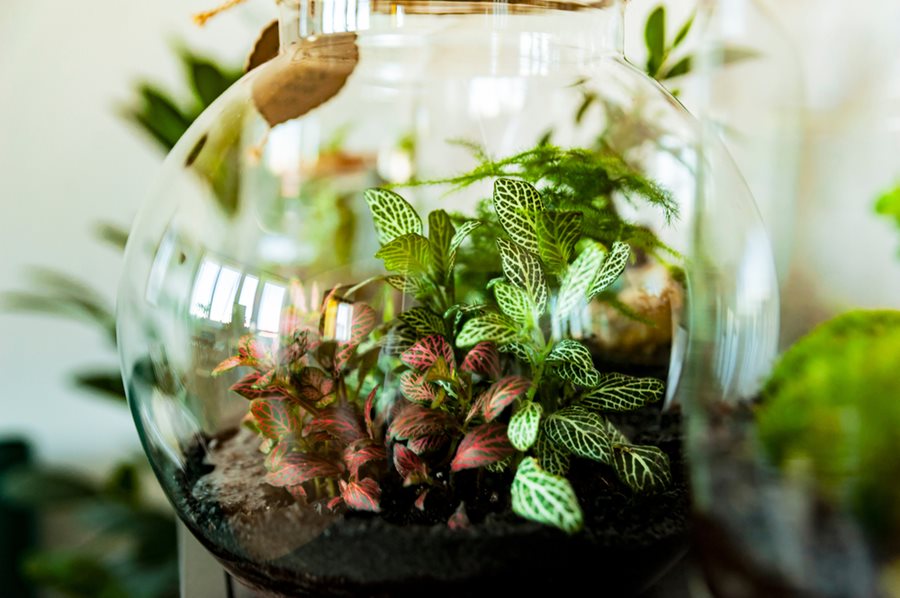
How to Layer Your Open Terrarium Like a Designer
The difference between a terrarium that looks purposeful and one that looks accidental almost always comes down to how it is layered from the bottom up. Before a single plant goes in, start with a drainage layer of coarse gravel or pebbles — at least one inch deep. Add a thin layer of activated charcoal above this to prevent bacterial buildup that would eventually sour the soil. Then add your cactus or succulent mix on top, deep enough to comfortably accommodate root systems without crowding them.
When placing the best open terrarium plants, work with three height zones rather than placing everything at the same level. Taller, vertical plants — small cacti, sansevieria, young aloe — belong toward the back or center where they provide structure. Mid-height rosette forms like echeveria and graptoveria occupy the middle ground, providing the visual focus of the arrangement. Low-growing plants like sedum varieties and scotch moss fill the foreground, creating a sense of ground cover that pulls the composition together.
Decorative finishing touches — small stones, colored sand, a piece of driftwood, a weathered rock — are worth adding once the plants are in place. They give the terrarium a completed, intentional quality and help anchor the overall visual theme.
Common Mistakes to Avoid With Open Terrariums
The most consistent mistake people make with open terrariums is using standard potting mix as the growing medium. Regular potting soil retains moisture far too effectively for drought tolerant terrarium plants. The correct approach is to use a dedicated cactus and succulent mix, or to create your own by blending standard potting soil with perlite in roughly equal proportions. This ensures water drains freely rather than sitting around roots.
The second common problem involves light and watering being mismatched. When a terrarium sits in a low-light position, the plants inside photosynthesise slowly and use water at a much slower rate than they would in brighter conditions. Continuing to water on the same schedule regardless of light levels leads to consistently wet soil and, eventually, root rot. Adjusting watering frequency to reflect actual light conditions — not a fixed calendar schedule — makes a significant practical difference.
Overcrowding is the third issue worth addressing directly. When a terrarium is first assembled, it is natural to want to fill every available space. But the best open terrarium plants need room for roots to develop and some airflow between their leaves. An arrangement that looks slightly sparse at the start will fill in naturally over several months as the plants establish and grow. Patience here produces a better long-term result than density for its own sake.
FAQs About the Best Open Terrarium Plants
What is the easiest open terrarium plant for beginners?
Haworthia and sansevieria are consistently the most forgiving starting points. Both tolerate low light, handle irregular watering without visible distress, and maintain their appearance reliably across a range of indoor conditions. If you are new to DIY terrarium gardening, beginning with one of these as the primary plant and building the arrangement around it is a sound approach.
Can I mix succulents and cacti in the same open terrarium?
Yes, and the combination tends to produce visually striking results. Both groups share compatible requirements — bright light, fast-draining soil, and infrequent watering — which makes them genuinely compatible in the same container. One practical note: handle cacti carefully during planting. A folded piece of newspaper wrapped around the plant or a pair of tongs provides a simple but effective barrier against spines.
How often should I water the best open terrarium plants?
Most open terrarium plants need watering somewhere between once a week and once every three weeks, depending on the season, the ambient temperature, and how much natural light the terrarium receives. Rather than following a fixed schedule, check the soil directly — press a finger about an inch below the surface. If the soil feels dry at that depth, water lightly. If it still feels cool or slightly damp, wait a few more days before watering again.
Do open terrariums need drainage holes?
Most glass terrarium containers do not have drainage holes, which is why the gravel drainage layer at the base is so important. This layer acts as a reservoir, holding any excess water below the root zone so that the soil above does not remain saturated. Some experienced terrarium builders include a thin layer of activated charcoal between the gravel and soil to further reduce the risk of bacterial growth and odor over time.
Which open terrarium plants work best in low-light rooms?
Haworthia, zebra haworthia, and sansevieria are the most reliable choices for rooms with limited natural light. Air plants can also manage in medium-low light conditions if misted consistently. Most cacti and the majority of other succulent terrarium plants need more light than a typical interior room provides — without it, they begin to etiolate, stretching toward the nearest light source and losing their characteristic compact form.
Conclusion
A well-chosen open terrarium can hold its shape and remain genuinely attractive for years with relatively little intervention. The best open terrarium plants share a set of qualities that make them suited to this environment: tolerance for dry conditions, comfort in low-humidity air, compact growth habits, and enough visual character to make the arrangement worth looking at day after day. Whether the goal is a minimalist desert composition built around lithops and fine sand, a colorful rosette arrangement anchored by echeveria and graptoveria, or a structural display centered on sansevieria and small cacti, the right plants make the difference between something that struggles and something that genuinely thrives.
The practical starting point is simple. Choose three plants from this list that appeal to you visually, gather a glass container, a bag of cactus mix, some coarse gravel, and a few decorative stones, and assemble your first open terrarium. The process takes under an hour. Done well, with the right plants in the right conditions, what you build this weekend could still be sitting on your shelf looking healthy and attractive a year from now.