You do not need a garden. You do not even need a yard. A few grow bags, some good compost, and a reliably sunny corner are all it genuinely takes to grow some of the sweetest strawberries you have ever tasted. If that sounds too simple to be true, keep reading — because it really is that achievable.
Growing strawberry plants in grow bags has steadily become one of the most practical and rewarding choices a home grower can make, and the reasons behind that reputation hold up under scrutiny. The method suits beginners without overwhelming them, works well in tight spaces, and consistently delivers results that impress. Whether your outdoor space is a compact city balcony or a generously sized patio, this approach adapts to fit your situation.
Here is exactly how to do it properly, from the first bag to the final harvest.
Why Grow Bags Are Actually a Smart Choice for Strawberries
Before getting into the practical details, it helps to understand what makes grow bags such a good match for strawberries in the first place.
Strawberry plants in grow bags benefit from a growing condition that traditional in-ground beds often struggle to provide: controlled, consistent drainage. Strawberries are sensitive to waterlogged roots. Excess moisture sitting around the root zone is one of the leading causes of crop failure, and the breathable fabric construction of grow bags addresses this directly. Water moves through the walls freely, and the root zone stays aerated, which is precisely what strawberry plants need to stay vigorous.
The disease management aspect is equally worth noting. Soil-borne pathogens such as Verticillium wilt can persist in garden beds for years, making replanting risky. With grow bags, you start each season with fresh compost, which removes that threat almost entirely. It is a simple reset that makes a meaningful difference to long-term plant health.
There is also the practical matter of mobility. Strawberry plants in grow bags can be repositioned as the seasons shift — moved to follow the sun, brought to a sheltered spot ahead of frost, or rearranged to make room for other things. For anyone growing in a rented property, that kind of flexibility is genuinely valuable.
Choosing the Right Grow Bag Size and Material
One of the most common early errors when setting up a grow bag gardening system is choosing bags that are too small. It is an easy mistake, and it limits your results before you have even started.
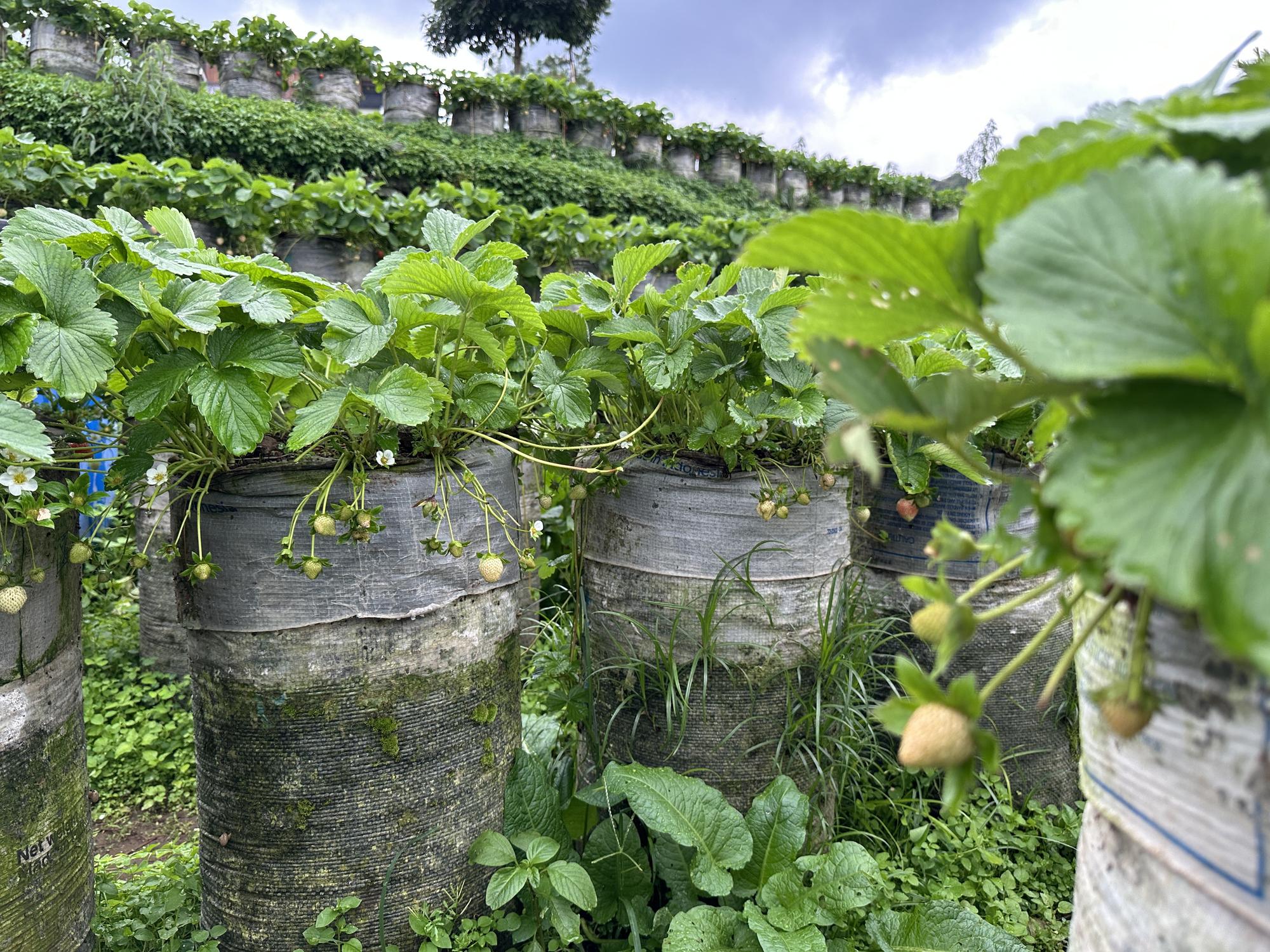
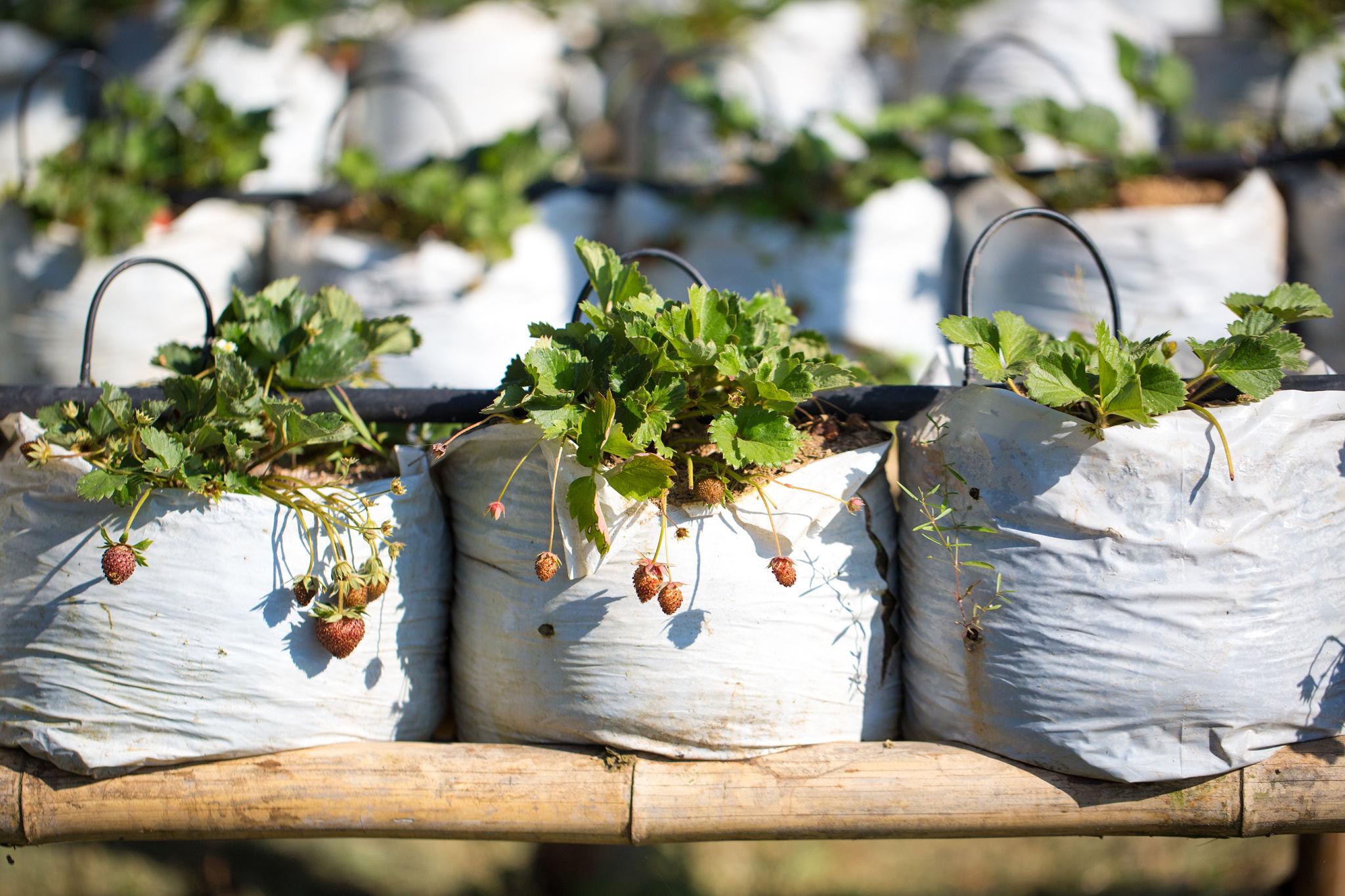
For strawberry plants in grow bags, a minimum capacity of 5 to 10 gallons is a reliable guideline when planting more than one or two plants together. A standard 5-gallon bag comfortably accommodates two to three plants with enough room for healthy root development. If you are drawn to vertical planting — and many growers are once they see how well it works — look for tower-style bags designed with multiple side pockets. These allow eight to twelve strawberry plants in grow bags to grow from a single bag, which is a genuinely efficient use of limited space.
The fabric itself matters more than most buyers initially realise. When selecting the best grow bags for strawberries, prioritise these material qualities:
- Thick felt fabric (non-woven polypropylene) — breathable construction that encourages air pruning of roots, resulting in a denser, more productive root system
- BPA-free materials — a basic but important consideration when growing food intended for consumption
- UV-resistant construction — bags treated for UV exposure hold their shape and integrity across multiple seasons, making them a better long-term investment
Thin, lightweight bags may seem cost-effective initially, but they tend to sag and deteriorate under the weight of wet compost. They are also harder to manage and rarely last a full growing season without showing signs of wear.
The Best Strawberry Varieties for Grow Bags
Variety selection is one area where a little research pays dividends. Not every strawberry cultivar is well-suited to container gardening strawberries, and choosing the wrong one can leave you with disappointing yields despite doing everything else correctly.
When growing strawberry plants in grow bags, the ideal variety is compact in habit, productive relative to its size, and capable of performing well in a confined root zone.
| Variety | Type | Bag Suitability | Flavour Profile | Fruiting Season |
|---|---|---|---|---|
| Albion | Everbearing | Excellent | Sweet, mild | Spring to Autumn |
| Seascape | Everbearing | Excellent | Rich, full | Spring to Autumn |
| Alexandria | Alpine | Outstanding | Intense, wild | All season |
| Honeoye | June-bearing | Good | Classic sweet | Early summer |
| Fragaria vesca | Alpine | Outstanding | Nutty, aromatic | Extended season |
| Mara des Bois | Everbearing | Excellent | Complex, deep | Summer to Autumn |
For the majority of home growers, everbearing varieties represent the most practical option. Rather than concentrating all their energy into a single fruiting period, these plants produce steadily across the season in successive flushes. The result is a manageable, ongoing harvest rather than a brief window of abundance followed by a long wait.
Alpine varieties such as Alexandria and Fragaria vesca deserve attention too. The individual berries are smaller, but the flavour is often more concentrated and complex than standard supermarket types. They are also notably tolerant of container life, making them a reliable choice for balcony strawberry gardens.
June-bearing varieties like Honeoye suit growers who want one substantial, defined harvest. Just bear in mind that achieving a meaningful strawberry yield per plant will require setting up more bags than you might initially plan for.
Getting the Soil Mix Right (This Part Actually Matters)
Soil preparation is where many otherwise well-intentioned growing projects fall short. The assumption that any off-the-shelf potting compost will perform equally well in a grow bag is understandable, but it is not accurate.
Strawberry plants in grow bags require a growing medium that achieves two things simultaneously: it must drain efficiently to prevent root saturation, and it must retain adequate moisture so the plants are not left dry between waterings. A blend of high-quality peat-free compost and perlite in roughly a 70/30 ratio meets both requirements well. The compost provides structure and nutrients while the perlite improves drainage and resists the compaction that naturally occurs as a bag settles over a growing season.
Before filling your bags, work a slow-release fertiliser into the mix. A balanced formulation with an NPK ratio around 10-10-10 provides a solid nutritional foundation for early growth. Strawberry plant care in containers demands more attention to feeding than in-ground growing, simply because the available nutrient supply is finite and depletes more quickly.
Garden soil taken directly from the ground is not suitable for this application. It tends to compact heavily in container environments, drains poorly, and frequently introduces disease-causing organisms that can establish and spread with little resistance. Starting with purpose-mixed compost every season is the right approach and produces consistently better results.
How to Plant Strawberries in Grow Bags Step by Step
The planting process itself is not complicated, but one specific detail — the depth at which the crown sits — has a disproportionate effect on how well each plant establishes and performs.
Fill the bag to approximately two-thirds of its capacity with your prepared compost mix, then follow these steps:
- Create a planting hole wide and deep enough to receive the root ball without compressing or bending the roots
- Set the plant in position so the crown — the junction point between the root system and the emerging foliage — sits at exactly the level of the surrounding compost surface, neither above nor below it
- Firm the compost gently but thoroughly around the root ball to eliminate air pockets
- Water the plant in well immediately after planting
- Add compost to bring the fill level to roughly 2–3cm below the rim of the bag, which allows for watering without spillage
The crown position is not a minor point. Plant it too deep and the crown is prone to rotting in contact with damp compost. Plant it too shallow and the plant dries out before it can establish, and root exposure becomes a problem. Getting this right at the outset saves considerable trouble later.
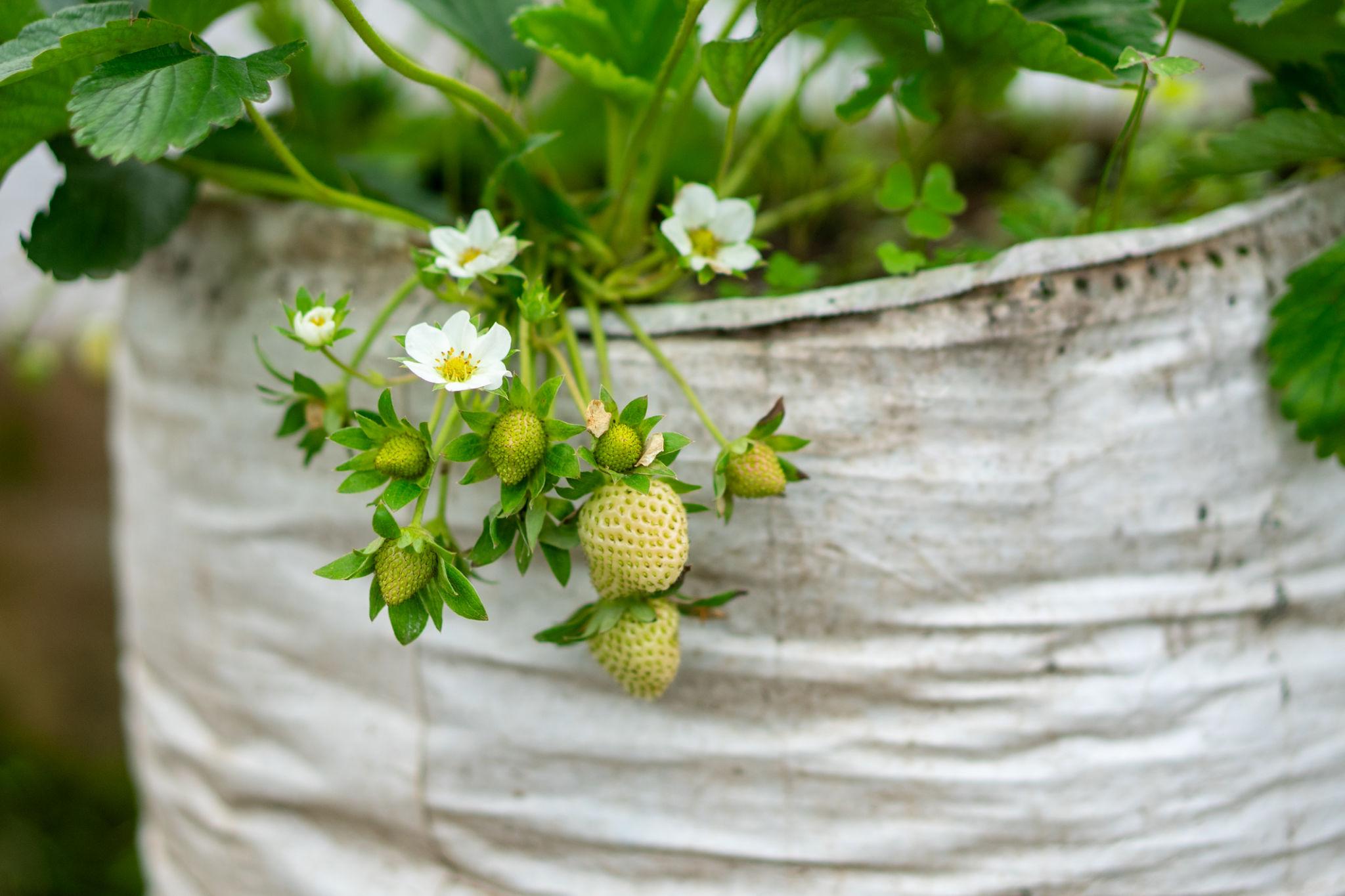
For tower-style vertical grow bags with side pockets, place one plant per pocket with the crown sitting just at the outer edge of the opening, visible but not protruding. These vertical systems are well-suited to small-space growing and, when planted correctly, look as good as they perform.
Watering and Feeding: The Rhythm That Drives Results
If there is one area of strawberry plant care in grow bags that requires consistent attention throughout the season, it is watering. The same breathable fabric that promotes healthy drainage and root aeration also means the growing medium dries out considerably faster than it would in a solid ceramic or plastic container. During warm, dry spells, checking the bags once or even twice a day is not excessive — it is simply necessary.
The most reliable way to judge when watering is needed is also the simplest: press a finger about an inch into the compost. If it feels dry at that depth, the plant needs water. If there is still perceptible moisture, it can wait another few hours. Watering on a rigid daily schedule regardless of conditions leads to over-watering just as often as under-watering, and both create problems.
Feeding strawberry plants in grow bags follows a clear seasonal rhythm that is worth planning for in advance:
- From planting through to the first visible flower buds: A balanced liquid fertiliser applied every two weeks supports healthy leaf and root development
- From first flowers onwards through the fruiting period: Switch to a high-potassium tomato feed applied weekly; this directly supports flower development and fruit set
- After fruiting concludes: Reduce feeding significantly and allow the plants a period of rest before resuming a light balanced feed in early spring
Potassium is the nutrient most directly linked to flowering and fruit quality in strawberries. Many growers who are otherwise diligent about their strawberry growing tips overlook the importance of switching to a high-potassium feed at the right moment, and then find themselves puzzled by a lower-than-expected strawberry yield per plant. A consistent weekly tomato feed during the flowering and fruiting period is one of the most impactful adjustments you can make.
Dealing With Common Problems in Grow Bag Strawberries
Even when growing strawberry plants in grow bags under reasonably controlled conditions, certain problems do appear. Knowing what to look for and how to respond keeps minor issues from becoming significant ones.
Slugs and snails tend to be less troublesome with elevated grow bags than in traditional garden beds, but they remain a persistent presence. A band of copper tape applied around the rim of the bag discourages them effectively. Checking the bags after dark and removing any slugs by hand is less convenient but thoroughly reliable.
Botrytis (grey mould) develops in conditions where air circulation is poor and foliage or fruit stays damp for extended periods. Keeping bags spaced apart, removing spent leaves and damaged fruit promptly, and directing water at the base of the plant rather than overhead all help to prevent its development.
Aphids tend to colonise the undersides of leaves, where they can go unnoticed until the infestation is established. Regular inspection, particularly of newer growth, is the best early warning system. A directed jet of water is often sufficient to remove them. Encouraging ladybirds, which are effective natural predators, provides ongoing passive control.
Nutrient deficiency shows up in recognisable patterns. Yellowing between the veins of otherwise green leaves is a reliable indicator of iron deficiency, which occurs more often when the compost is alkaline. A liquid iron supplement resolves it promptly. Pale, even yellowing across whole leaves more commonly points to nitrogen deficiency, in which case increasing the frequency or strength of your balanced feed is the appropriate response.
Runner management is a seasonal task that many first-time growers overlook. Strawberry plants in grow bags produce runners — trailing stems with small plantlets at the tip — as part of their natural growth habit. These can be rooted in small pots and grown on as replacement plants, which is a cost-effective way to maintain your supply. During the main fruiting period, however, allowing too many runners to develop draws energy away from fruit production. Removing them as they appear keeps the plant focused on what you are growing it for.
A Real-World Example: A Balcony Strawberry Setup That Worked
A helpful illustration of how to grow strawberries at home without much space comes from a grower who transformed her second-floor flat balcony — roughly 8 square metres in total — into a productive growing area using nothing more than a modest collection of grow bags and a consistent routine.
She set up six standard 7-gallon bags alongside two tower-style vertical bags, planting a mix of Albion and Mara des Bois across all of them. By midsummer she was harvesting a substantial bowlful of fruit every three to four days for approximately six weeks — a yield that genuinely surprised her and that required no specialist equipment or prior growing experience.
Her approach was straightforward throughout. She watered each morning, switched to a weekly tomato feed as soon as the first flowers appeared, and checked regularly for slugs. Runners were removed as soon as they appeared, keeping each plant’s energy directed toward fruit rather than propagation. The tower bags, in particular, stood out for their efficiency — eight plants occupying barely any floor space, producing steadily across the season.
What made the practical difference in her results was not any single technique but the combination of good-quality peat-free compost mixed with perlite, correct crown depth at planting, and a feeding routine that she stuck to consistently rather than varying from week to week. Growing strawberry plants in grow bags on her previously unused balcony proved to be one of the most satisfying and productive decisions she made as a home grower.
Overwintering and Year Two: Getting More From Your Plants
One of the less obvious advantages of choosing strawberry plants in grow bags is that the investment extends well beyond a single season. Strawberries are perennial plants. With appropriate care through the colder months, they will return the following spring ready to fruit again, which means the initial cost of good plants and quality compost continues to deliver returns across multiple years.
As the growing season draws to a close and fruiting slows, the following steps will prepare your plants for winter:
- Cut back the old foliage, leaving the crown and about 10cm of stem intact
- Remove all dead and decaying plant material from and around the bags to reduce the risk of disease carrying over
- Relocate the bags to a position that offers some shelter — against a house wall is a reliable choice that provides both physical protection and some residual warmth
- Water occasionally through winter during dry spells, but far less frequently than during the growing season
- Resume a balanced liquid feed in early spring as new growth begins to emerge
After two to three full growing seasons, most strawberry plants naturally begin to decline. Vigour reduces and yields shrink. At that point, rather than purchasing new plants, take runners from your most productive specimens, pot them on through summer, and use them to restock your bags for the following year. It is an efficient, low-cost cycle that keeps your grow bag gardening setup continuously productive.
Frequently Asked Questions
How many strawberry plants fit in one grow bag?
Bag capacity determines the answer. A standard 5-gallon bag comfortably holds two to three plants with adequate space for root development. A 10-gallon bag will support four to five. Tower-style bags designed with side pockets accommodate eight to twelve plants in a single bag — a highly space-efficient option for smaller growing areas.
Do strawberry plants in grow bags need full sun?
Consistent, direct sunlight is important for productive strawberry plant care. A minimum of six hours of sun per day is the general benchmark, and a south- or west-facing position typically delivers this reliably. Plants grown in partial shade remain healthy in appearance but produce fewer flowers, and the fruit that does form tends to be less sweet than sun-ripened berries.
Can I reuse the compost from my grow bags next year?
Starting with fresh compost each season is the recommended approach. After a full growing season, the compost will have lost much of its nutritional value, may have developed compaction that limits drainage, and could carry pathogens from the previous crop. A fresh start with clean compost is a straightforward way to maintain consistent plant health and growing strawberries in containers at their best.
When is the best time to plant strawberries in grow bags?
For bare-root plants, early spring — March through April in the UK, or following the last frost date in other regions — provides the ideal establishment window before the growing season begins in earnest. Container-grown plants purchased from a garden centre are more flexible and can typically be planted from spring through early summer without significant disadvantage.
Why are my strawberry plants in grow bags not fruiting?
Several factors commonly account for this. Insufficient direct sunlight is often the primary cause. An excess of nitrogen in the feeding programme encourages leafy growth at the expense of flowers and fruit. In the case of plants raised from runners, fruiting in the first year is limited by design, as the plant directs energy toward root establishment. Missing the transition to a high-potassium feed at flowering is another frequent cause of reduced strawberry yield per plant.
Conclusion
Growing strawberry plants in grow bags consistently earns its reputation as one of the most rewarding and accessible approaches to home fruit growing. The method is forgiving enough for beginners and productive enough to satisfy experienced growers. With the right variety, a well-prepared compost mix, attentive but not obsessive watering, and a feeding routine aligned to the plant’s seasonal needs, the results speak clearly for themselves.
The essential point is this: the fundamentals matter more than any single advanced technique. Choose an appropriate grow bag size, get the crown depth right at planting, make the switch to a high-potassium feed when the flowers appear, and give your strawberry plants in grow bags a consistent, reliable environment. Those steps, applied steadily across a season, produce results that are hard to achieve through any amount of guesswork or improvisation.
Begin with two or three bags this season, observe what works in your specific conditions, and build from there. Most growers who try strawberry plants in grow bags find themselves planning a larger setup well before the first season is over.